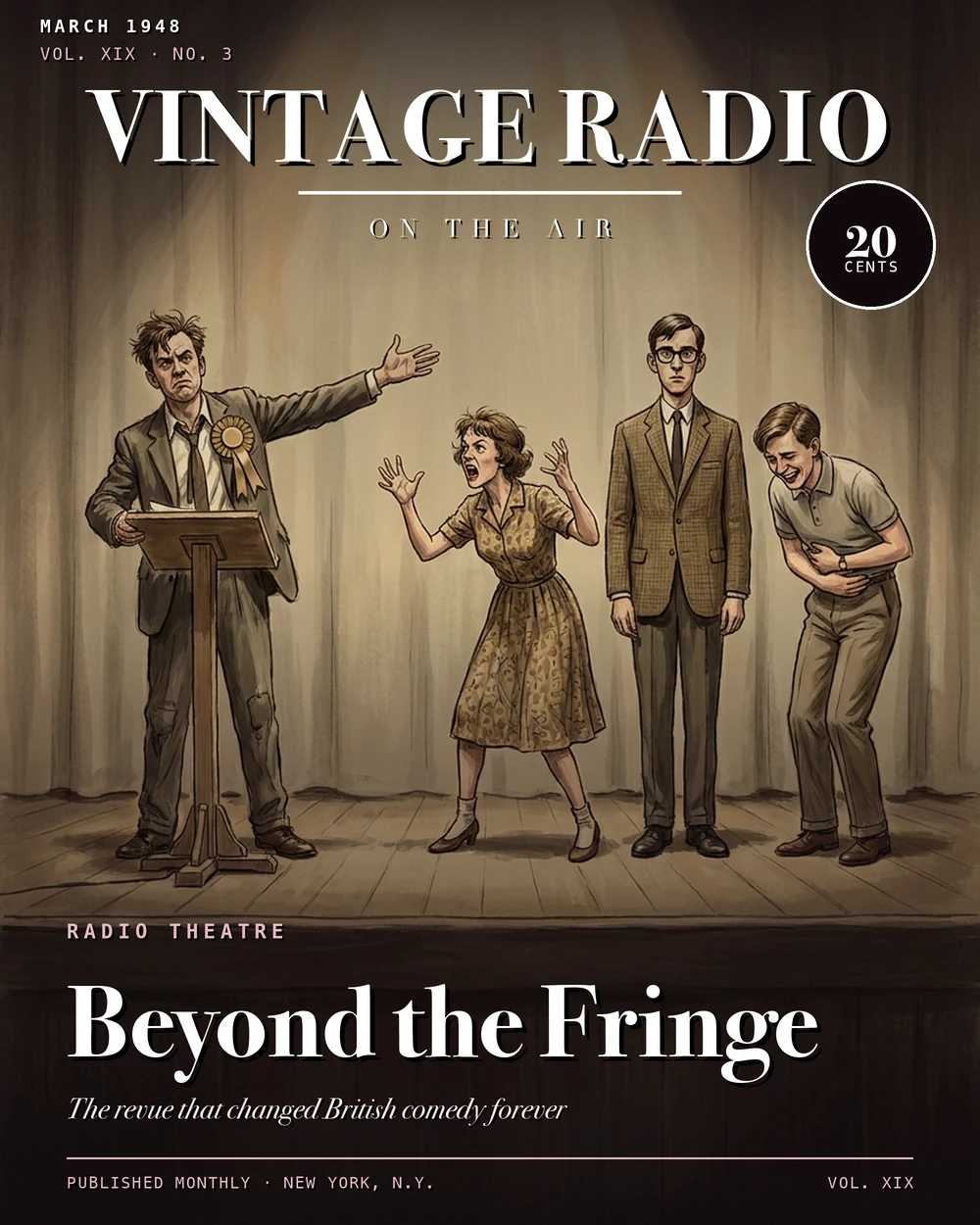
Beyond the Fringe
How It Started
The story of Beyond the Fringe begins with a lunch. Robert Ponsonby, director of the Edinburgh International Festival, wanted to stage a late-night revue drawing on the sharpest comic talent coming out of Cambridge Footlights and the Oxford Revue. His assistant John Bassett started the recruitment by finding Dudley Moore first. Moore suggested Alan Bennett. Jonathan Miller and Peter Cook followed. By the end of that meal, the four had agreed to put the show together.
The title itself carried a quiet piece of attitude. When the revue premiered on August 22, 1960 at the Royal Lyceum Theatre in Edinburgh, it was part of the main Edinburgh International Festival — not the Edinburgh Festival Fringe. The name was chosen deliberately to suggest the show went beyond what the Fringe could offer. That combination of self-assurance and wit turned out to be a pretty accurate preview of what was inside.
Peter Cook and Jonathan Miller were Cambridge graduates. Dudley Moore and Alan Bennett came from Oxford. All four were Oxbridge-educated, and their particular strain of comedy — sharp, literary, willing to take aim at institutions most British entertainers left alone — came through in every sketch.
What the Show Actually Was
Beyond the Fringe was a stage revue, not a purpose-made radio programme. After Edinburgh, it moved to London's Fortune Theatre on May 10, 1961, directed by Eleanor Fazan, where it ran for over a year with the original cast. The Broadway run opened at the John Golden Theatre on October 27, 1962 and clocked 667 performances before closing on May 30, 1964. Humphrey Carpenter's 2000 study A Great, Silly Grin puts the West End performances at more than 1,500 across that London run.
The recordings that make up this catalog — 33 in all — derive from those performances rather than from any dedicated radio broadcast series. An original cast LP appeared on Parlophone in the UK in 1961, followed by a Broadway cast recording on Capitol Records in 1962. A BBC television farewell performance was recorded on December 12, 1964 and broadcast on BBC2. That television special, along with the audio recordings, gave the show its life beyond the theatre.
The sketch titles tell you something about the tone: "The English Way of Death," "Real Class," "Royal Box," "Take a Pew," "The Heat Death of Universe," "The Sadder and Wiser Beaver," "Sitting on the Bench." There's a running interest in British class, mortality, religion, and the gap between how institutions present themselves and how they actually operate.
What They Were Willing to Say
The show broke two conventions that British comedy had mostly observed without question: it lampooned the Royal Family, and it went after the sitting government. Peter Cook's impression of Prime Minister Harold Macmillan was sharp enough to be genuinely uncomfortable — and on at least one occasion, Macmillan himself was in the audience when Cook performed it.
The sketch "The Aftermyth of War" drew protests from some veterans for its treatment of British wartime mythology. The cast's position was that they were challenging the way the media had packaged and sentimentalised the war, not ridiculing the people who fought it. Whether or not every audience member accepted that distinction, the show kept the sketch in.
This willingness to aim at targets that had previously been considered off-limits was not incidental to the show's identity — it was the point. The satire wasn't decorative. It came from a genuine impatience with the gap between the way Britain's institutions were talked about and the way they actually functioned.
The Writing and the Music
Most of the sketches were written by Peter Cook, many drawing on material he had developed for earlier revues. The pieces written entirely fresh for Beyond the Fringe included "The End of the World," "TVPM," and "The Great Train Robbery."
Dudley Moore handled the musical dimension of the show, and his piano playing gave the revue a different texture from pure sketch comedy. The most famous musical moment was his arrangement of the "Colonel Bogey March," but Moore also contributed pastiches of Schubert, Kurt Weill, and Benjamin Britten — all of them shaped by the same comic intelligence that ran through the spoken material. The format, mixing theatrical sketches with musical numbers and clever wordplay, gave the four performers room to work in different modes without the show feeling fragmented.
What Came After
Beyond the Fringe is credited with helping start what became known as the 1960s satire boom in British comedy. Critic Humphrey Carpenter frames it as the inaugural event of that movement. The television programme That Was the Week That Was and the satirical magazine Private Eye — which Peter Cook co-founded and financially supported — both came out of the same cultural moment the revue helped create.
Cook and Moore went on to form a comedy duo, appearing together in the television series Not Only... But Also and the 1967 film Bedazzled. Cook also founded The Establishment club in London. Jonathan Miller left the show in 1963 to write for television and direct theatre; he later produced and directed a series of acclaimed BBC Shakespeare adaptations. Alan Bennett went on to a long career as a playwright and author.
Many of the people who would later make up Monty Python recalled being directly inspired by Beyond the Fringe, and the revue is consistently listed as a forerunner to At Last the 1948 Show and Monty Python's Flying Circus as well as That Was the Week That Was.
All four original cast members reunited to perform material from the show at the Amnesty International charity event Pleasure at Her Majesty's. The show's afterlife in dramatic form includes Roy Smiles' play Good Evening, broadcast on BBC Radio 4 in 2008 with Benedict Cumberbatch playing Dudley Moore, and Jeremy Front's comedy drama Behind Beyond the Fringe, which BBC Radio 4 broadcast in 2023.
The 33 Recordings
What this catalog holds are recordings that capture the revue as it existed in performance — the sketches, the music, and the particular dynamic among four performers who had figured out how to be funnier together than any of them was separately. The material in titles like "Portraits from Memory," "Porn Shop," and "The Death of Lord Nelson" reflects the range of the revue: historical, topical, absurdist, musical, occasionally provocative.
Beyond the Fringe was not built for radio, but the recordings transfer well because the comedy lives in the writing and the performances rather than in staging or spectacle. Cook's timing, Moore's musical wit, Bennett's dry observation, Miller's quick intelligence — all of it comes through in audio. Thirty-three pieces is a substantial collection from a show that ran for four years across two continents and reshaped what British comedy thought it was allowed to do.